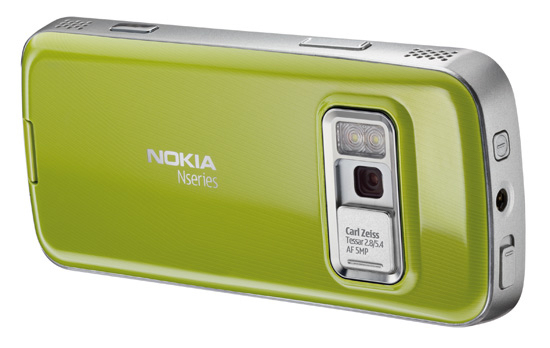
The Nokia N79, a new monoblock (candybar) Nseries handset, was announced today. It features a 5 megapixel camera (with LED flash and protective lens cover), automatic screen rotation via an accelerometer, touch sensitive NaviWheel, Xpress-on smart covers, WiFi and Bluetooth connectivity, TV-out, FM transmitter and integrated GPS. The N79 has out of the box support for the full range of Ovi services: Photos, Music, Maps, Video and Games (N-Gage). It will be available from October at a cost of €350 (£280) before taxes and subsidies. Read on for more.
The N79 continues the Nseries candybar form factor family (N70, N73, N78) and will sit alongside the N78 as a replacement for the N73. As such it can be considered an entry level Nseries device. It manages to fit a comprehensive hardware specification into a relatively low price point and should attract more style conscious consumers thanks to its personalisation features, the most notable of which are the Xpress-on smart covers.
The N85 will be one of the first Nseries handset to ship with the full range of current Ovi services and software on the handset. These include Photos / Share online, Music store, and N-Gage.
Xpress-on smart covers which automatically change the phone's theme when they are applied. 3 Xpress-on smart covers will be included in the retail box from a selection of five colours: Light Sea Blue, Espresso Brown, Olive Green, White and Coral Red.
Touch sensitive NaviWheel for scrolling in the user interface and automatic screen rotation via accelerometer sensor.
5 megapixel camera (2582 x 1938) with Carl Zeiss optics (aperture: F2.8, focal length: 5.2mm) and support for geo-tagging. The camera is accompanied by a LED flash/camera light and is protected by a small sliding shutter. Video capture is at VGA (640 x 480) at up to 30 frame per second.
Integrated FM transmitter (for sending music to another FM radio) and FM receiver (including RDS support).
4GB microSD memory card included in the retail box (some markets may vary) and 70MB of internal memory.
Dimensions of 110 x 49 x 15mm and weight of 97g (similar to N78 which is 113 x 49 x 15.1 mm). This makes it the smallest and lightest Nseries device so far.
BL-6F battery (1200 mAh) with quoted standby time of 406 hours. In the real world this should translate to a heavy day of use.
2.4" QVGA screen with up to 16 million colours.
3.5 mm stereo headphone jack (on the top of the device), which is also used for TV-out. Twin stereo speakers on the right hand side of the device (top and bottom).
Integrated GPS with support for A-GPS.
microUSB connector (Hi-Speed USB 2.0) for PC connectivity, media sync, USB mass storage and printing.
Bluetooth connectivity, including support for A2DP and AVRCP profiles (Bluetooth stereo headphones). WiFi (802.11b/g), including support for UPnP. Dual band WCDMA (900/2100) and quad band GSM cellular connectivity.
Key software features
Runs S60 3rd Edition Feature Pack 2 on Symbian OS 9.3.
Photos application on phone for viewing photos, organizing into albums, printing locally, and adding meta-data / tags. Share online application for uploading photos and video to Flickr, Share on Ovi and other web services, plus XpressPrint application for printing photos via the web. Bi-directional media sync between the Photos application on the handset and Nokia Photos for PC.
Music player (MP3, AAC, eAAC+ and WMA), with bi-directional sync with Nokia Music for PC. Nokia Music Store accessible via PC client of Music store application on the handset. Video playback via RealPlayer (H.264, H.263, WMV).
Nokia Maps 2.0 (3 months free navigation in selected markets) for drive or walk navigation.
N-Gage client application for direct download of games.
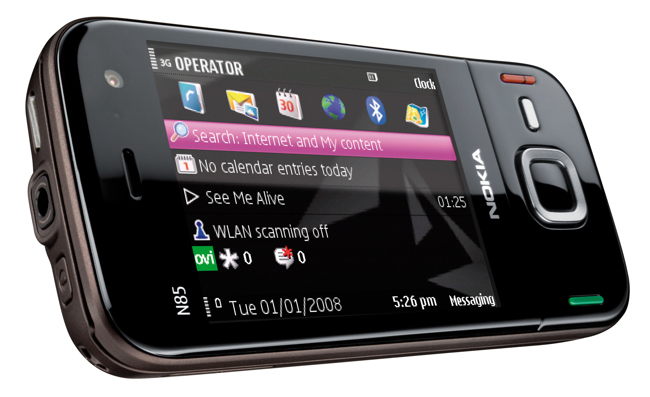
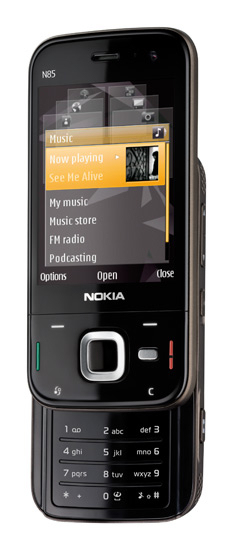
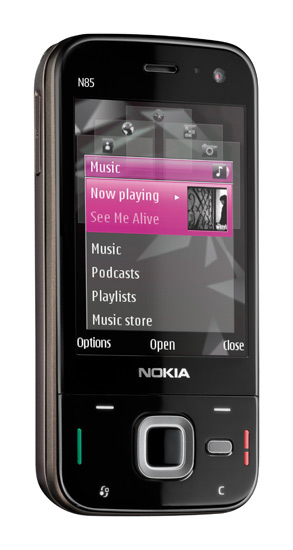
The Nokia N85, the latest edition to Nokia's Nseries range, was announced today. With AM OLED screen technology, tri-band WCDMA (3G) cellular radio, USB charging, and preloaded Ovi content and services, the multimedia-centric N85 delivers the latest evolution of Nokia's dual slider form factor.
The N85 boasts the usual impressive Nseries specification list: 5 megapixel camera (with dual LED flash and lens cover), integrated GPS, WiFi and Bluetooth connectivity, FM transmitter and TV-out. The N85 will be available from October at a price of €450 (£350) before taxes and subsidies. Read on for more.
The N85 is Nokia's smallest dual-slider Nseries handset so far and offers a number of key technological advancements (explained below). It manages to do this while significantly lowering the launch price compared to its predecessors (N95 family) and thus opens up the higher end of Nokia's Nseries portfolio to a wider audience. The N85 looks set to follow in the footsteps of the N73 and N95 as an iconic handset for Nseries.
In terms of positioning the N85 is a mid to high end Nseries and sits in between the N78/N9 and the N96. It can be seen as a replacement for the N80 and N81 and complimentary the N95 family.
The N85 follows the design language of the N96 and N78 with the 3D 'adzed' plastic on the back of the device, the hard silver / grey plastics on the side of the device and a predominantly flat, black and shiny plastic on the front of the device. It also has the hidden-till-lit control key cluster design, made from a single piece of plastic, but with each key having its own key dome.
The N85 will be one of the first Nseries to ship with the full range of Ovi services and software on the handset out of the box.
2.6 inch, QVGA (240 x 320) AM OLED screen with 16 million colours. AM OLED screens have a number of advantages: they generally draw less power, and have better performance for colour gamut, response time, and contrast. See below for more on AM OLED.
Tri-band WCDMA cellular and quad band GSM radios, which means 3G data connectivity or calling can be used worldwide. There will be three N85 variants: a European and Asian model (WCDMA 2100/1900/900), an Americas model (WCDMA 2100/1900/850) and an EDGE/GSM only model for the Chinese market. See below for an explanation of WCDMA bands.
USB charging. The N85 is the first Nokia S60 model to support USB charging and the first Nokia device to support simultaneous charging and data transfer. The microUSB (Hi-Speed USB 2.0) connector is also used for PC connectivity, media sync, printing and USB mass storage (client). The N85 does not have a 2mm power port, instead a microUSB charger (Nokia AC-10) will be provided.
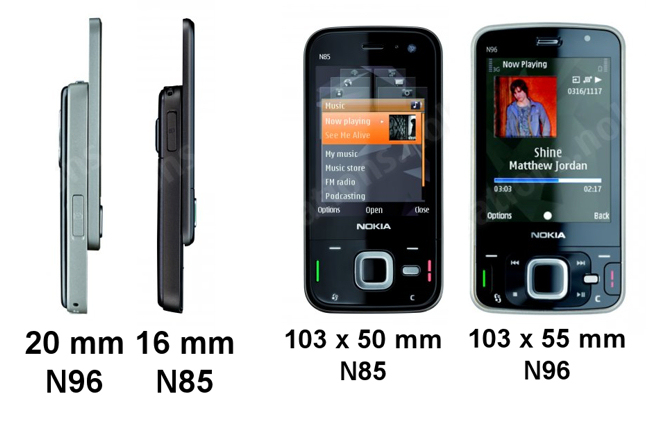
Dimensions of 103 x 50 x 16mm and a weight of 128g make the N85 at least 25% thinner than previous dual sliders (N95 8GB: 21mm, N96 20mm). It is also the smallest in overall volume at 76cc (N96 is 92cc, N95 8GB is 96cc).
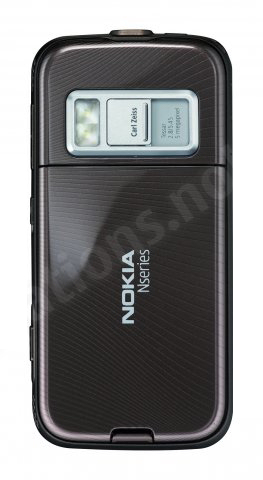
5 megapixel camera (2584 x 1938), which is protected by a sliding lens cover and accompanied by a dual LED flash/photo light and lens cover. The lens uses Carl Zeiss optics and has an aperture of F2.8 and focal length of 5.45mm. Video capture is at VGA resolution at 30 frames per second.
The camera's dual LED flash has optimised micro-optics. The gain is better than earlier devices with freshnel lenses. Essentially this means the flash will provide greater illumination. Using an LED flash means it can be used in both video and photo mode.
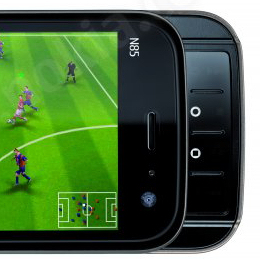
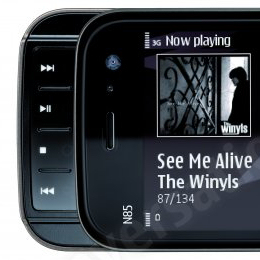
Intelligent key illumination - the upper slide keys illuminate according to their current function. In music and video playback, the multimedia shortcut controls are shown. In N-Gage games, two circles represent the dedicated gaming keys. Similarly, the control cluster only illuminates when the key functions are available (e.g. switched off in camera mode).
Touch sensitive NaviWheel for scrolling in user interface. Auto screen rotation powered by integrated accelerometer sensor.
8GB microSD memory card included in the box. 70 MB of internal memory with 128 MB of RAM (around 75MB free after boot up).
Integrated FM transmitter (as first seen in the N78) and FM radio with RDS support.
3.5mm stereo headphone jack (on the top of the device), which is also used for TV-out. Twin stereo speakers are located on the top and bottom of the right-hand-side of the device (above and below the volume and camera capture keys respectively).
Integrated GPS (with support for A-GPS), which is used for GPS navigation and geotagging photos. The GPS antennae is located on the back of the, near the top end of the device around the camera area. This should give it the optimum position for reception regardless of the slide mode.
WiFi (802.11b/g) and Bluetooth connectivity, including support for A2DP and AVRCP profiles (Bluetooth stereo headphones).
Nokia BL-5K battery (1200 mAh) with quoted standby time of 300 hours. 25 hours of music playback (offline mode). In the real world this should be sufficient for a day of heavy usage.
The in-box accessories for the N85 are stereo headset/controller (HS-45/AD-54), high power charger (AC-10), connectivity cable (CA-101), 8GB microSD card, and TV-out cable (CA-75U).
Key points about the N85 software:
Runs S60 3rd Edition Feature Pack 2 on Symbian OS 9.3.
Photos application on phone for viewing photos, organizing into albums, printing locally, and adding meta-data/tags. Share online application for uploading photos and video to Flickr, Share on Ovi and other web services, with XpressPrint application for printing photos via the web. Bi-directional media sync between Photos application on the handset and Nokia Photos for PC.
Music player (MP3, AAC eAAC+ and WMA) and Nokia Music Store applications on the handset. As with current handsets (in some markets) a few music tracks are likely to be preloaded on the memory card. Intially the Nokia Music Manager software will be used for side loading. Nokia Music PC client, currently in beta, may replace this at a later date.
Video Centre can be used to download video on the device via RSS feed. (H.264, H.263, RV 8/9/10, and WMV). WMV can be handled at VGA resolution at 30 frames per second (downsized to QVGA on handset, but full resolution used for TV-out). Side loading of videos is supported by Nokia Video Manager.
UPnP software suite for controlling remote UPnP servers, control points and renderers, making on-device multimedia available to other UPnP devices, and syncing on-device media to UPnP server. A Nokia-branded version of Simple Center software is included in the box.
Nokia Maps 2.0 (3 months free navigation in selected markets) for driving or walking navigation will be available out of the box. Maps for the appropriate local area will be preloaded on the microSD card.
The full N-Gage client application will be available out of the box. The N85 will ship with 15 N-Gage games preloaded and there will be an in-box voucher that will let you activate one of these games for free.
N85 Video demo, courtesy of Nokia Conversations
AM OLED Screen Technology
The N85 has a new screen technology - AM OLED, but what is it and what does it mean for you?
OLED, also known as LEP (light emitting polymer), is a screen made up of small dots of organic polymers that, when charged with electricity, emit light. The advantage of OLED displays are that they are generally brighter, have a better colour gamut (numbers of colours that can be accurately displayed at same time), have better contrast ratio, have a better response time, have better viewing angles and use less power. In contrast to traditional TFT LCD displays they do not require a back light.
AM OLED is a technology that combines the active matrix back plane, from a traditional TFT screen, with an OLED display. AM OLED displays, because of their active matrix nature, are quicker to switch pixels and thus give better performance for fast moving, on-screen changes such as animation and video.
What this means is that the N85's screen, compared to earlier Nseries devices, will have:
Reduced power consumption. In normal uses cases AM OLED requires 30-40% less power than a LCD screen. The power used is related to what is shown on the screen - the darker the screen the less power is used, conversely a predominantly white screen will use more power.
A better contrast ratio (ratio of the luminance of the brightest color, white, to that of the darkest color, black). Roughly 1:1300 compared to 1:500. Black is truly black on an AM OLED screen as there is no back-light and therefore no 'light-leakage'.
A better viewing angle - around 180°.
A greater number of different colours on the screen at one time.
A brighter screen for the same amount of power.
Tri-Band WCDMA
The N85 has tri-band WCDMA cellular radios in two different variants - a European and Asian one (WCDMA 2100/1900/900), an Americas one (WCDMA 2100/1900/850). Previously Nokia has had dual band WCDMA devices.
There are four commonly used WCDMA bands:
Band I: (WCDMA 2100) in Europe, Africa, Asia, Oceania and Brazil
Band II: (WCDMA 1900) in North America and South America
Band V: (WCDMA 850) in Australia, Brazil, Canada, the USA, other parts of South America, and parts of Asia
Band VIII: (WCDMA 900) in Europe, Asia, Oceania, and Australia
Tri-band WCDMA means that the N85 should be usable, in 3G mode, in most countries. Currently 2100 and 1900 are the most commonly used bands.
10 Upcoming Nokia Phones in 2008 i have decided to showcase all the upcoming Nokia mobile phones so that users can get a preview and compare, while they are making up their mind if they are planning to get a new feature rich Nokia Phone.
Nokia is the market leader in the mobile phone and it has some ambitious plans to challenge the other players who are biting away its market share.
It will be interesting to see how Nokia keeps its turf considering that now Apple has done with one phone what Nokia did with many. Here is the list of mobile phones that Nokia will release this financial year.
Nokia N96 Description:The Nokia N96 is a multimedia computer which optimized for video and TV. With a large 2.8" screen, 16 GB of internal memory and support for high-quality videos in a wide range of formats. Accessing internet videos is quick and simple and supports common video formats including MPEG-4, Windows Media Video and Flash Video, making favorite videos easy to watch. Transferring and accessing videos is even faster with the high-speed USB 2.0 connection and WLAN and HSDPA support, Bluetooth v2.0 (with A2DP), Infrared port, A-GPS, DVB-H TV broadcast receiver, Java MIDP 2.0, Music player, Office document viewer, Push To Talk (PTT), Built-in handfree. Launch: October-November 2008
Nokia 7610 Supernova The Nokia 7610 Supernova is the flagship mobile phone of the Supernova lineup. It is based on the S40 user interface, this slider phone packs quad-band GSM/EDGE support, 3.2 megapixel auto focus camera, a 16M color QVGA display, FM radio with RDS and a microSD memory card slot and Bluetooth 2.0 for connectivity. Launch: October-November 2008 Nokia 7510 Supernova The Nokia 7510 Supernova boasts an unique fold able design with a push-to-open side key.Nokia 7510 sports a FM Radio, an enhanced MP3 player, access to Nokia Music Store and Nokia Music PC Client. Additional features include a link to YouTube, access to Nokia Maps 1.2 to navigate with free mapping, routing and local search, support of A-GPS and the Nokia WidSets service. Launch: January-February 2009
Nokia 7210 Supernova The Nokia 7210 Supernova has a chic, slim design and available in a choice of 'bubble gum pink' and 'vivid blue' in a gloss finish. It is the most affordable phone of the Supernova series. The phone has 30 MB of internal memory which can extended upto 2 GB. Other features are 2 megapixel camera, 240 x 320 megapixel display, USB 2.0, Bluetooth 2.0, Flash Lite 3.0 and MIDP Java 2.1 with additional Java APIs. Value for Money. Launch: October-November 2008
Nokia 6600 Fold The Nokia 6600 fold is not as bulky as its predecessor of the same name. It presents a smooth, minimalist design and many easy-to-use features. Nokia 6600 fold has 2.0 megapixel camera with secondary VGA videocall camera, Bluetooth v2.0, USB 2.0v, Java MIDP 2.0 , Stereo FM Radio, Mp3 player and supports GSM 850 / 900 / 1800 / 1900.T he outer display reveals time, incoming messages and missed calls. Launch: October-November 2008
Nokia 6600 slide The Nokia 6600 Slide is a sleek handset which incorporates high fashion with new technology at reasonable price. The Nokia 6600 Slide has 2.2" QVGA resolution screen which supports up to 16 million colors, it has 3.15 MP camera, auto focus, video(VGA 15fps), flash, secondary video call camera, Bluetooth v2.0, USB 2.0v micro, Java MIDP 2.0, Stero FM Radio with MP3/AAC/AAC+/eAAC+/WMA player and supporting GSM 850/900/1800/1900. Launch: October-November 2008 Nokia 3600 slide The Nokia 3600 slide is a quad-band portable phone, supporting GSM 850/900/1800/1900. The Nokia 3600 slide features a 3.2 megapixel auto focus camera with 8x digital zoom, USB 2.0 Full Speed, Bluetooth 2.0 +EDR, Bluetooth stereo, Flash Lite 3.0 and MIDP Java 2.1 with additional Java APIs. Launch: October-November 2008 Nokia 6212 classic The slim Nokia 6212 classic comes with an extensive set of features such as a 2 megapixel camera, bright 2-inch QVGA display, stereo FM radio and music player supporting multiple formats, Bluetooth v2.0 with A2DP, mini USB, MIDP 2.0 and supportS GSM 850 / 900 / 1800 / 1900. An optional microSD memory card of up to 4GB can be used. Launch: October-November 2008 Nokia 7070 Prism Nokia 7070 Prism has a folding design with geometric patterns, resembling diamond cuts and external light effects. The phone is bundled with special wallpapers, ringtones and themes. It includes voice recorder and integrated hands-free speaker with 128 x 160 pixel TFT display, an indicator light on the outside. It supports GPRS for basic web browsing and has an email client too. The internal memory is mere 11 MB which can be extended by a memory card. Its look-alike Nokia Prism 7500 is already in the market. Launch: October-November 2008
Nokia 2680 Slide The Nokia 2680 slide is a slim entry level phone that offers decent functionality which includes an FM radio with recording capability and MP3 ringtones, audio messaging, Bluetooth, Java MIDP 2.0 With supporting GSM 900 / 1800. The integrated digital camera ensures spontaneous moments are captured and shared. Launch: October-November 2008
Rumored for a few weeks now as the N95's successor in waiting, the mighty N96 dual slider has gone all official on us at Mobile World Congress today. Though the phone it replaces is still a beast by any measure, the N96 pushes the envelope further by packing a solid 16GB of storage internally in addition to a microSD slot, something the N95 8GB lacks. The 5 megapixel autofocus camera with Carl Zeiss Tessar lens carries over, but there are now two LEDs doing flash and video light duty. The 2.8 inch QVGA display will come in handy for the integrated DVB-H mobile TV tuner, while a 3.5mm headphone jack, A2DP, and integrated stereo speakers should handle audio with aplomb. Other features include WiFi, AGPS, and morphing lights on the smaller second slide that hook the user up with game controls when it's time to relax with a little N-Gage action. Unfortunately, the first version of the N96 (and the only version announced thus far) supports HSDPA only on the 900 and 2100MHz bands, but we imagine the strength of the spec sheet should still be enough to sell a few of these stateside when it launches in the third quarter for €550 (about $797).
128MB RAM, 256MB system memory (operating system plus dynamic user data area)
Maps and Navigation
Built-in GPS receiver, with support for assisted GPS (A-GPS)*
Nokia Maps application
Free downloadable maps of over 150 countries, millions of locations, location details and satellite imagery**
Upgrades available for purchase: Multimedia city guides and Navigation services: Drive - voice guided car navigation, or Walk - pedestrian-optimized turn-by turn guidance
* A-GPS is a network dependant feature that requires a data plan. Additional charges may apply.
** Downloading satellite images may involve the transmission of large amounts of data through your service provider’s network. Contact your service provider for information about data transmission charges.
E-mail and Messaging
Easy-to-use email client with attachment support for images, videos, music and documents
Support for SMTP, IMAP4, POP3, MMS, SMS. Unified SMS/MMS editor
Compatible with Nokia Wireless Keyboard SU-8W (sold separately)
Browsing and Internet
Nokia Web Browser with Mini Map, visual history, HTML and JavaScript support, Flash Lite 3.0 and Flash video support
RSS reader
Connectivity
WLAN - IEEE802.11 g/b with UPnP support
Hi-Speed USB 2.0 with Micro USB type B interface
3.5mm stereo headset plug , TV-out support (PAL/NTSC)
Bluetooth 2.0 with A2DP stereo audio and Enhanced Data Rates (EDR)
Nokia Nseries PC Suite connectivity with USB and Bluetooth wireless technology
Imaging
Main camera
Up to 5 megapixel (2592 x 1944 pixels)
Carl Zeiss Optics: Tessar™ lens
Auto-focus, auto-exposure
F-number/aperture: F2.8
Focal length: 5.2 mm
Focus range 10 cm to infinity
Dual-LED camera flash, video light, recording indicator, auto-focus assist light
Secondary camera
VGA (640 x 480 pixels) sensor
Video Recording
Video capture in MPEG-4 up to VGA at 30 fps
Digital Video Stabilization
Video clip length: limited by storage
Video file format: .mp4 (default), .3gp (for MMS)
Settings for scene, video light, white balance, color tone
Photography
Still Image resolutions: up to 5 Megapixel (2592 x 1944 pixels)
Still Image file format: JPEG, EXIF
Location tagging: automatic insertion of capture location into images
Settings for scene, flash, sequence, self-timer, color, white balance, contrast, exposure compensation, guides
Music Features*
Digital music player – supports MP3, AAC, eAAC+, WMA, album art
Playlist editing and sharing
Equalizer and visualization
Search, browse and purchase songs online in Nokia Music Store – with support for Windows Media DRM protected files
* Nokia Music Store availability varies by country.
Radio*
Stereo FM radio (87.5-108MHz, 76-90MHz) with support for RDS, Visual Radio™ and use of FM radio in offline mode
Nokia Internet Radio
Video Center
Video center: central hub for video experiences
Access to last played video and easy resume
My videos: collection of stored videos
Access to Internet Videos, compatible with RSS feeds and video podcasts, with direct wireless updates and downloads
Service catalog to discover new Internet Videos
Video Codecs and Formats
MPEG-4 Part 2 (H.263/SP), up to VGA 30 fps, hardware-accelerated codec, scaled to max QVGA on device screen, or max SDTV on TV-out
MPEG-4 Part 10 (H.264/AVC), up to VGA 30 fps, hardware-accelerated codec, scaled to max QVGA on device screen, or SDTV on TV-out
Windows Media Video (WMV9), up to CIF/QVGA 30 fps, hardware-accelerated codec, scaled to max QVGA on device screen, or SDTV on TV-out
RealVideo QCIF at 30 fps
Flash video support in browser
DRM support: OMA DRM 1, OMA DRM 2, WM DRM
Live TV
Broadcast Television (DVB-H) capable -DVB-H based mobile TV with internal antenna -DVB-H Class C, 470-750 MHz
Browser-based video access
Support for download, streaming and progressive download
Approx. memory capacity indication with included 2GB microSD card: -Video (VGA @ 15fps): up to 120 min -Photos (3.2 megapixel): up to 3,400 photos -Music (eAAC+): up to 1,500 tracks*
* Capacity based on 3:45 per song with 48 kbps eAAC+ (M4A) encoding on the Nokia Audio Manager. Capacity with 128 kbps AAC encoding is up to [550] songs.
Power Management*
Battery: Nokia Battery BL-6F 1200mAh
Talk time: up to 190 minutes (WCDMA); 260 minutes (GSM)
Stand-by time: up to 320 hours (WCDMA); 320 hours (GSM)
Still images: up to 375 pictures (3.2 megapixel)
Video capture: up to 215 minutes (VGA @ 15fps)
Video call: up to 125 minutes
Video playback: up to 280 minutes (VGA @ 15fps)
Music playback: up to 24 hours (offline mode)
Web browsing: up to 3 hours (3.5G)
FM radio: up to 14 hours
*Operation times may vary depending on radio access technology used, operator network configuration and usage.
Display and User Interface
2.4” QVGA (240 x 320 pixels) TFT color display with up to 16 million colors and wide 160° viewing angle. Ambient light detector - to optimize display brightness and power consumption
Dual mode WCDMA 900/2100 (HSDPA) with simultaneous voice and packet data (PS max speed UL/DL= 384/3.6MB, CS max speed 64kbps)
Dual Transfer Mode (DTM) support for simultaneous voice and packet data connection in GSM/EDGE networks. Simple class A, multi slot class 11, max speed DL/UL: 118.4/118.4 kbits/s
EGPRS class B, multi slot class 32, max speed DL/UL= 296 / 177.6 kbits/s
*Actual achieved speeds may vary depending on network support.
Imaging and video
3.2 megapixel (2048x1536 pixels) camera, Carl Zeiss Optics, Tessar™ lens, 20x digital zoom, MPEG-4 VGA video capture of at 15 fps
Secondary camera, CIF (352x288 pixels) sensor
On device photo editor (manual & automatic) and video editor (manual).
2.4” QVGA (240 x 320 pixels) TFT color display with up to 16 million colors and wide 160° viewing angle. Ambient light detector - to optimize display brightness and power consumption
Nokia XpressShare solution - share easily from Photos application or after capture via email, by using Bluetooth connectivity or MMS.
Video call and video sharing support (WCDMA network services)
Online album/blog: one click image/video uploading from Photos application or camera post-capture view
Tag images automatically with capture location and show on a map where they were captured.
Transfer and organize photos and video between your device and compatible PC with Home Media solution.
Nokia XpressPrint solution – online printing service or direct printing via USB, Bluetooth connectivity (BPP), WLAN (UPnP), from compatible memory card.
Mobile Video
Video resolutions: up to VGA @ 15 fps
Audio recording: AAC stereo, 48kHz
Digital video stabilization
Video clip length: max 60 min per clip
Video file format: .mp4 (default), .3gp (for MMS)
White balance: automatic, sunny, cloudy, incandescent, fluorescent
Scene: automatic, night
Color tone: normal, sepia, B&W, negative
Zoom: Digital up to 8x
Mobile Photography
Still image resolutions: 3.2 megapixel (2048x1536)
Still image file format: JPEG/EXIF
Auto focus
Auto exposure - center weighted AE
Exposure compensation: +2 ~ -2EV at 1/3EV step
White balance : automatic, sunny, cloudy, incandescent, fluorescent
Scene: automatic, user, close-up, landscape, night, night portrait
Colour tone: normal, sepia, B&W, negative
Zoom: Digital up to 20x
LED flash
Secondary camera, CIF (352 x 288) sensor
Camera Specifications
CMOS, 3.2 megapixel (2048x1536)
Carl Zeiss optics: Tessar™ lens
Focal length: 4.6 mm
Focus range: 10 cm ~ infinity
Macro focus distance: 10 cm - 30 cm
Music Features
OMA DRM 2.0 support for music.
Integrated FM transmitter* (88.1 – 107.9 MHz)
Nokia Internet Radio
Stereo speakers
Nokia Stereo Headset HS-45/AD-54
Digital music player: supports MP3/ AAC/ AAC+/ eAAC+/ WMA with playlists, equalizer and album art.
Synchronize music with Windows Media Player 10 & 11.
Rip your CDs with one click, converting and transferring music to your device using Nokia Music Manager
Stereo FM radio (87.5-108MHz /76-90MHz) with Visual Radio™ support
Navigation
Integrated Assisted Global Positioning System (A-GPS)
Pre-installed Nokia Maps application and downloadable maps*
Comes with a selection of the regional maps
E-mail
Easy-to-use email client with attachment support for images, videos, music and documents
Compatible with Nokia Wireless Keyboard SU-8W (sold separately)
Browsing
Nokia Web Browser with Mini Map
Web feeds support (RSS)
xSP framework support
Digital home
Access multimedia content on your compatible home media network over UPnP.
Automatically synchronize your mobile and home content with Home Media solution
Java Applications
Java™: MIDP2.0
Over-the-air download of Java-based applications and games
Other Applications
Personal Information Management (PIM)
Advanced S60 PIM features including contacts, calendar, to-do list, notes, recorder, calculator, clock, converter
Office applications: Quickoffice supports viewing of common e-mail attachments and Adobe PDF Reader
Setting wizard for easy configuration of e-mail, push to talk and video sharing
Data transfer application for transfer of PIM information from other compatible Nokia devices
WLAN wizard
Connectivity
WLAN IEEE802.11 b/g with UPnP support
USB 2.0 high-speed through micro USB connector
Bluetooth wireless technology 2.0 + EDR
Nokia AV connector 3.5mm
Nokia Nseries PC Suite connectivity with USB, and Bluetooth wireless technology
Local synchronization of contacts and calendar to a compatible PC using connection
Remote over-the-air access to your home content with ORB
Automatic synchronization with Home Media Solution
Send and receive images, video clips, graphics, and business cards via Bluetooth wireless technology
RealPlayer media player
Full-screen video playback to view downloaded, streamed or recorded video clips
Supported video formats: MPEG-4, H.264/AVC, H.263/3GPP, RealVideo 8/9/10, Flash 3.0
Earn money by receiving Sms Earn cash By Receiving Sms All Indians who have mobile and are above 18 y.o can earn money by receiving Ad sms Visit http://www.paisa4sms.com/Index.aspx?Inviteid=105690 Sign up and receive sms and money Earn cash without any pain. Cheers ==============================================================
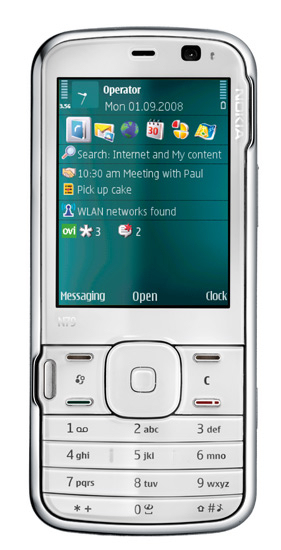 The N79 continues the Nseries candybar form factor family (N70, N73, N78) and will sit alongside the N78 as a replacement for the N73. As such it can be considered an entry level Nseries device. It manages to fit a comprehensive hardware specification into a relatively low price point and should attract more style conscious consumers thanks to its personalisation features, the most notable of which are the Xpress-on smart covers.